Train and Empower Your Team
The Hiring Decision Framework Every Small Business Needs
This post may contain affiliate links which may compensate us at no cost to you. See details here.
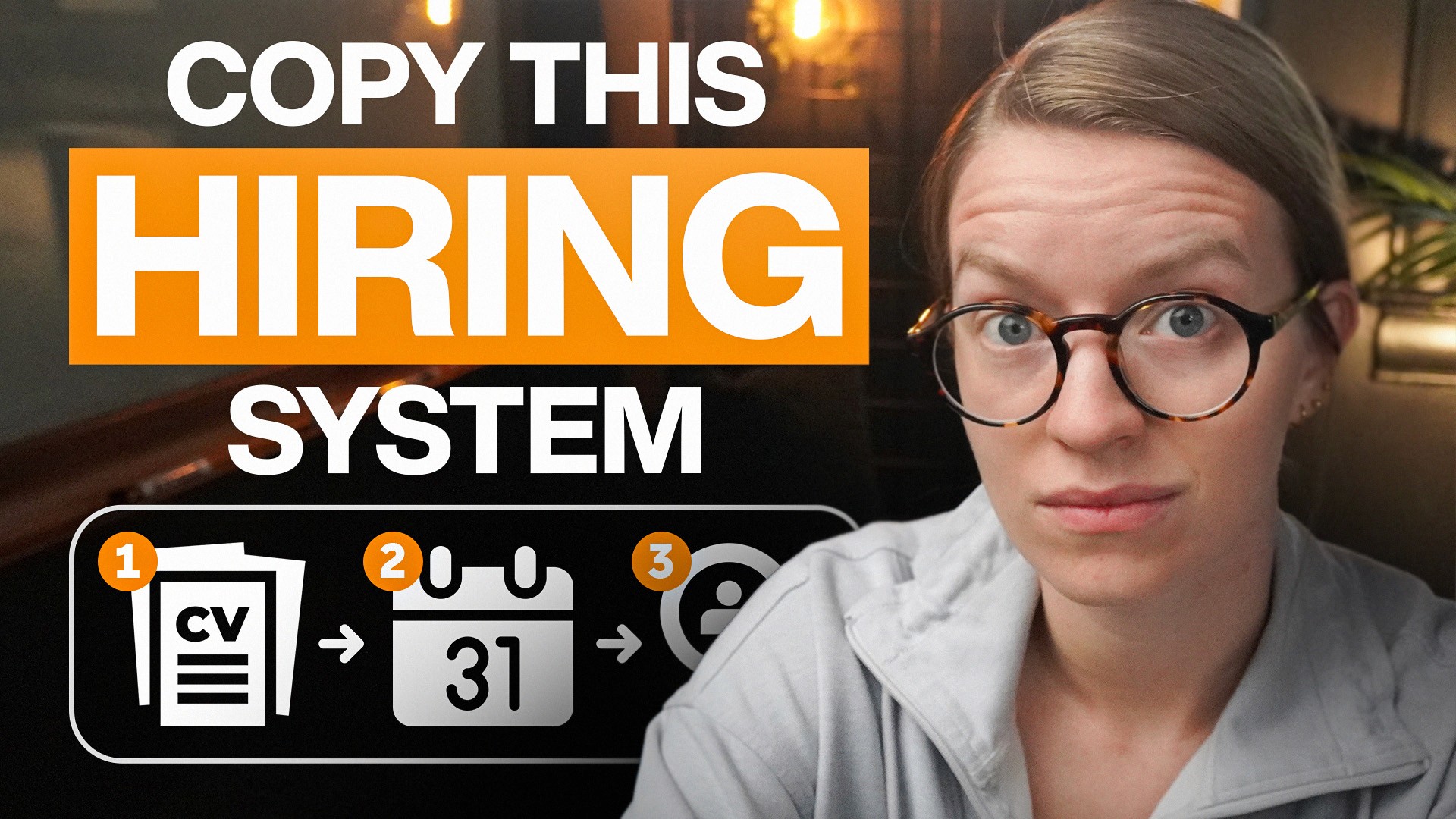
When a small business owner is drowning in work, the default solution is usually to hire — but throwing people at the problem isn't always the smartest or most cost-effective move. Before adding headcount, there's a better question to ask: what does this situation actually need? This post walks through a practical 5-question hiring decision framework for figuring out whether to bring on an employee, hire a contractor, use AI or automation, or simply stop doing the thing altogether.
Start Here: Get Clear on What's Actually Overwhelming You
Before any decision can be made, there needs to be clarity on what's causing the bottleneck. What are the specific tasks, actions, or responsibilities that are slowing everything down? If the answer isn't immediately obvious, a structured bottleneck identification process is a great starting point before moving forward.
[REFERENCE LINK]
🔗 Identify the biggest bottleneck in your business
Once that's clear, work through the following five questions in order.
The 5-Question Hiring Decision Framework
Question 1: Would Delegating This Add More Value Than It Costs?
Value here means more than just money — it includes time, energy, emotion, and anything else that matters to the business. The question is whether handing this off would, on the whole, return more than it costs.
Sometimes the math is direct: a salesperson who closes deals that otherwise wouldn't happen clearly generates more than their cost. Other times it's less obvious. The key reframe is this — if someone else were handling this task, what would that free time be used for? If the answer is higher-value work, the delegation almost certainly pays for itself.
If delegating something would cost more than it generates in any meaningful way, the answer isn't to delegate. It's to delete it entirely. Some tasks aren't worth doing at all, and the sooner they're off the list, the better.
[TIMESTAMPS] (Jump to the full explanation with real examples in the video)
00:00 Introduction: Should you hire or is there a better solution?
00:20 The 4 options when you're drowning in work (employee, contractor, AI, or change)
01:01 Step 1: Would delegating this add more value than it costs?
02:15 When the answer is just DELETE it
02:52 Step 2: Could you just pause this activity?
03:10 Real example: pausing the ProcessDriven Facebook group
04:55 Step 3: Can AI or automation handle this?
05:37 The tinkerer warning — don't waste more time than you save
06:07 The 2-month rule for AI and automation ROI
07:29 Step 4: Does this work come up consistently?
08:08 When to hire a contractor or freelancer
09:09 Step 5: Is this renting expertise or hiring a vendor?
10:34 When hiring an employee is the right answer
11:03 What to do once you've decided to hire
Question 2: Could You Just Pause This?
Before assuming something needs to be delegated or automated, consider whether it needs to happen at all right now. A temporary pause — stopping an activity for a defined period to see what actually happens — is one of the most underused tools in a small business operator's toolkit.
Pausing is low-risk and reversible. If the pause reveals the activity wasn't generating meaningful results, it can be removed from the list permanently. If it turns out the activity does matter, it can be restarted with much more clarity about its value. Many small business owners spend hours every week on tasks that have never been proven to be worth doing. A pause is the quickest way to find out.
Question 3: Can AI or Automation Handle This?
If pausing isn't the right call, the next question is whether technology can take this off the plate entirely. AI and automation tools are evolving rapidly, and it's worth exploring before defaulting to human delegation.
One important caveat: exploration should be time-boxed. A useful rule of thumb is the 2-month rule — if the time spent building an automation can be recovered within two months of using it, it's worth pursuing. If it would take 10 hours to automate something that saves 5 minutes once a year, that's not a return worth chasing.
For those who are comfortable with technology, this is often the fastest and most cost-effective solution. For those who aren't, the remaining questions below cover human delegation options.
Question 4: Does This Work Come Up Consistently?
If AI or automation isn't the right fit, it's time to think about human delegation — and the first question is whether the work is consistent or project-based.
Inconsistent work that comes up occasionally is typically well-suited to a contractor or freelancer. Someone who can step in on a per-project basis, bring the right expertise, and step back out without the overhead of a full hire. This is especially true for specialized work that doesn't justify a permanent role.
Question 5: Is This Renting Expertise or Hiring a Vendor?
Some work is best handled by renting a professional's knowledge rather than building it in-house. A vendor, subcontractor, or specialist brought in for a defined scope of work can often deliver faster and more cost-effectively than a new hire — without the long-term commitment.
If none of the above categories fit — if the work is consistent, ongoing, core to the business, and not suited to a vendor or contractor relationship — then it's likely time to consider adding a full employee role, provided cash flow supports it.
Once You've Decided: Making the Delegation Actually Work
Deciding to hire or automate is only half the equation. The other half is making sure whoever or whatever is taking on the work knows what to do and how to do it well. The good news is that doesn't require years of documentation and hundreds of SOPs.
The free Systemization Snapshot is a great starting point for understanding what's already working in the business and where the documentation gaps are before handing anything off.
[ADDITIONAL REFERENCE LINKS]
🔗 Will I see you in Philadelphia in September 2026?
🔗 Watch Leila Hormozi's Process for Hiring Employees for Your Small Business
The goal isn't to hire less or more — it's to make the right call every time. Work through these five questions before the next hiring decision, and the answer will be a lot clearer.

IF YOU'RE NOT SURE WHERE TO START, TRY