Fix Work That's Not Flowing
How to Hire Freelancers for Your Small Business: A 6-Step Process That Actually Works
Tuesday, August 18, 2026
This post may contain affiliate links which may compensate us at no cost to you. See details here.
Most small business owners know they need to hire — they just keep waiting for things to calm down first, which never happens. This post walks through the full 6-step freelancer hiring process built and refined over years of real delegating, including the expensive early mistakes, so you can skip straight to what actually works.
Why Small Business Owners Wait Too Long to Hire
The logic usually sounds something like: things will calm down in a few months, and then there will be time to figure out the hiring piece. But that calm never arrives. And the longer the wait, the harder it gets.
The other common mistake is hiring before confirming the role is actually worth filling. The first contractor hire at ProcessDriven was for social media — a channel that wasn't generating any business at the time. Money spent, nothing gained. Step one of this process exists specifically to prevent that.
00:00 How to hire freelancers for your small business (6-step process)
01:30 Step 1 - Confirm you are hiring for a real need
02:39 Step 2 - Define the scope of what you're delegating
03:20 Three examples of contract roles we've hired for
08:03 Step 3 - How to test for a contractor's ability to deliver
11:31 Step 4 - How to screen applicants before the test project
13:42 Step 5 - Grade the test project(s) and respond
15:29 Step 6 - How much time the full process actually takes
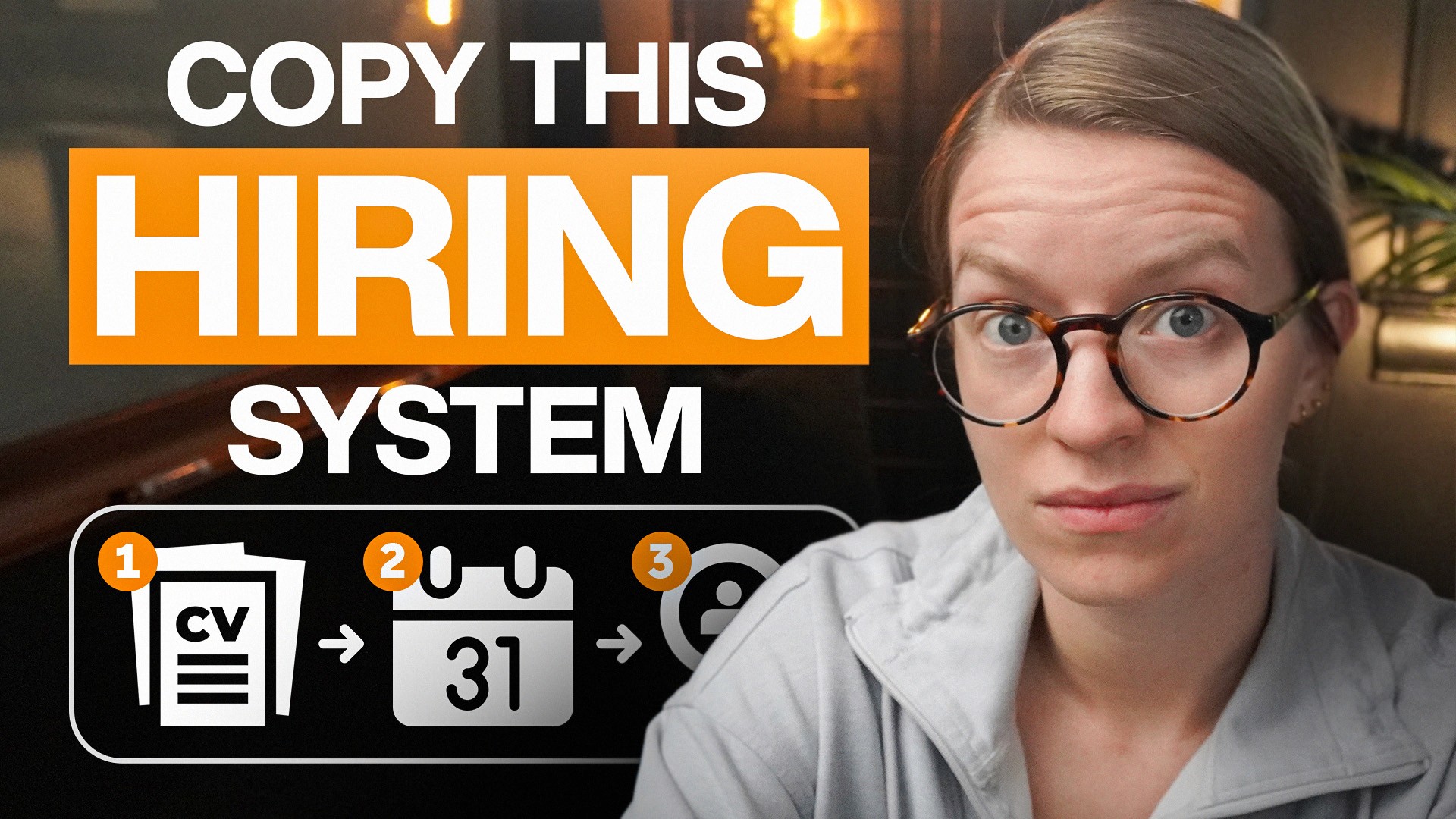
The 6-Step Freelancer Hiring Process
Step 1 Confirm It's a Real Need
Before writing a job post or talking to a single candidate, get clear on whether this hire is actually going to move the business forward. The bar is simple: has this type of work proven valuable, or will getting it off the plate free up time to do something that directly generates more value?
If neither is true, the right move is to stop doing the thing entirely — not pay someone else to do it.
Step 2 Define the Scope and Deliverables
Once the need is confirmed, define exactly what the contractor needs to deliver. Think of it as the scope of work section in a contract — specific, measurable bullet points that make it clear when the job is done and done well.
Three real examples from recent ProcessDriven hires:
YouTube Editor — One deliverable: take raw footage and produce a coherent, edited video that doesn't lose the personality in the process.
ProcessDriven Coach — Four deliverables: conduct client audits, host calls well, create session templates, and follow up proactively without being asked.
Fit Advisor — One deliverable: host discovery calls with excellence.
The more specific the deliverables, the easier every step that follows becomes.
Step 3 Define How to Test for Each Deliverable
For every deliverable, decide how to assess whether a candidate can actually do it. The gold standard is real work — hand a YouTube editor raw footage and see what comes back. When real work isn't possible, get as close as you can.
For fit advisors at ProcessDriven, candidates were surprised mid-interview with a live mock discovery call — no warning, no prep, no safety net. That's because contractors aren't employees. There's no training period built in. A freelancer should be able to perform from day one, which means the hiring process needs to confirm that before any commitment is made.
Step 4 Screen and Run Paid Test Projects
Before the test project, a quick application screen can help filter the pool. A few targeted questions — graded with clear yes/no criteria — is usually enough to surface who's worth the next step.
From there, the goal is the test project: paying candidates to actually deliver the work. Free test projects exist, but 30 minutes of work rarely reveals anything meaningful. A more useful benchmark is roughly 5 hours of work for around $500, which signals that the work should be taken seriously and that candidates' time is respected.
A typical test project pool runs 2–8 people depending on the role. YouTube editor? Two or three. Coach role with more nuance to assess? Closer to six to eight.
When grading, prioritize candidates who submit early. Someone who delivers ahead of deadline in a hiring process is telling you exactly how they'll operate on the job.
Step 5 Run a Real-World Trial Contract
Once the test projects are graded and top candidates are identified, the next step is a limited real-world trial — a small scope of actual work under a formal contract. Four videos. Eight calls. Whatever makes sense for the role without locking into a long-term commitment before there's enough data.
Always use a contract, even for short trials. If the contractor doesn't have their own, create one. Framing it explicitly as a trial keeps expectations clear on both sides and gives the flexibility to bring in multiple candidates at once if the test project didn't produce an obvious winner.
In two of the three recent ProcessDriven hires, two to three times the needed number of contractors were brought into the real-world trial — because the right fit only becomes obvious once the actual work starts.
Step 6 Decide, Respond, and Repeat If Needed
After the trial, the right choice is usually obvious. When it is, move forward and send respectful wrap-up messages to anyone who isn't continuing. When it isn't, run the process again — the second round almost always produces a stronger candidate pool because the questions get sharper and the criteria get clearer.
As for the time investment: done solo, this process takes about six hours end to end. With a team member running it, closer to one hour of owner involvement. Either way, that's less than a week of 30-minute daily sessions — and a whole lot less than the ongoing cost of doing the work yourself indefinitely.
The free Freelancer Hiring Spreadsheet in the description has the full process laid out and ready to use.
[REFERENCE LINKS]
🔗 Do you need to hire? Watch this video.
🔗 Want to grab the spreadsheet? Get your copy here.
Hiring doesn't have to be the thing that keeps getting pushed to someday. With a clear process, it's just another system — and eventually, one that runs without you.


IF YOU'RE NOT SURE WHERE TO START, TRY